What if children could understand their feelings in a simple, playful way?
Chinese Medicine teaches that we all have five elements within us: Wood, Fire, Earth, Metal, and Water. Each represents different strengths and challenges. One element may be stronger, but we all have access to all five.
For example, a child with strong Water energy may be shy or cautious. By adding a little Fire – like talking about something they love – they can build confidence and courage. A child with strong Wood energy may be bold or bossy. By adding Water – pausing, listening, and going with the flow—they learn flexibility.
This isn’t about labeling children. It’s about giving them tools.
When kids understand their natural tendencies, they can learn how to balance them. The more they practice using tools that support their challenges, the more balanced and resilient they become.
The Five Elements offer children a simple language for emotions, behavior, and growth. It helps them see that nothing is “wrong” with them – they are simply learning how to use their elements wisely.
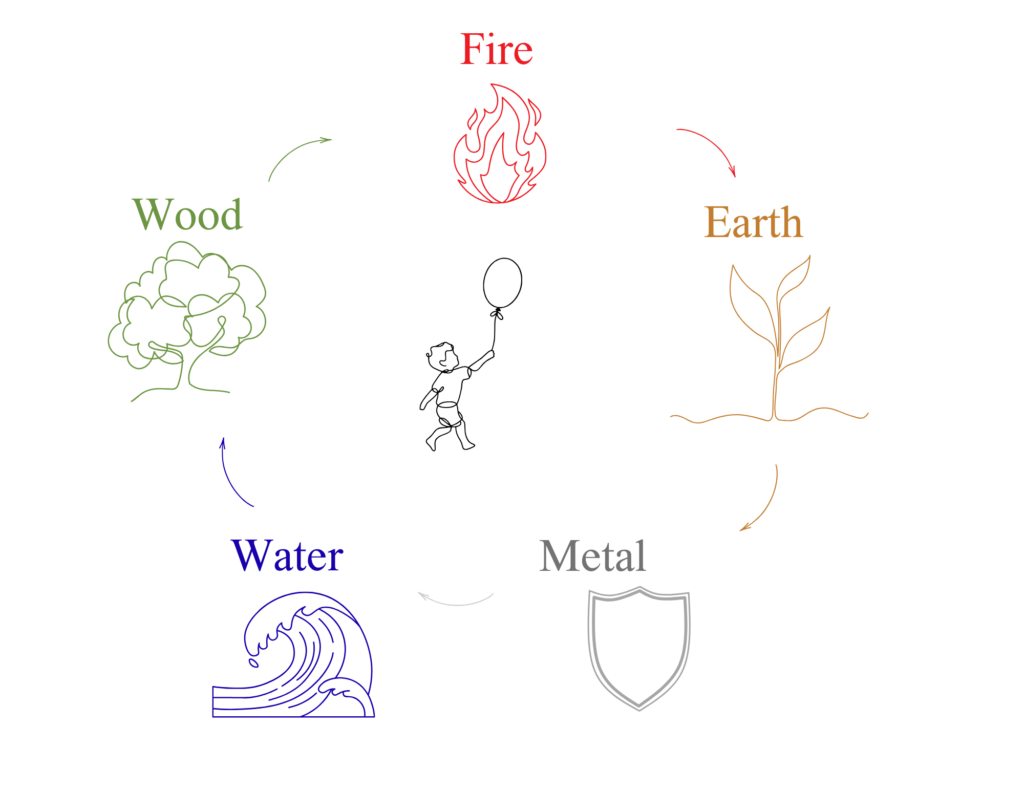
How to Use the Five Elements as Tools
When something feels hard, we can intentionally “add” another element to help restore balance. Here’s how:
Wood (the Leader)
If a child feels bossy or needs to control everything, we can add Water — practice going with the flow, taking a breath, and allowing someone else to lead.
Fire (the Spark)
If emotions feel too big or overwhelming, we can add Wood — use movement. A silly shake-out dance or funny exercise gives those big feelings somewhere to go.
Earth (the Helper)
If a child feels stuck in worry or self-pity, we can add Wood — make a small plan and take one action step forward.
Metal (the Thinker)
If a child is hard on themselves for mistakes, we can add Fire — find a way to laugh about it and bring warmth to the moment.
A Real Example
I worked with a tween who was struggling with constant teasing at school. Every time someone said something mean—whether it was about his style, his height, or how he answered questions in class—he’d freeze up, get upset, and say things like “That’s not fair!” or “Why are they doing this?”
His Metal element was very strong. Metal is about structure, rules, fairness, and what’s “right.” When Metal is too rigid, it makes us defensive and unable to bend. Because he took everything so seriously, the teasers loved getting a reaction from him—and they kept doing it.
We talked about adding Fire—specifically, self-humor.
At first, he resisted. “Why should I make a joke when they’re being mean to me?” But I explained: Self-humor isn’t about making fun of yourself in a hurtful way. It’s about showing that their words don’t have power over you. It takes away what they want—your upset reaction.
He decided to try it.
The next time someone teased him about being the tallest kid in class, instead of getting defensive, he said with a smile: “Yeah, the weather’s great up here. Want me to check the forecast for you?” When someone made fun of his outfit, he shrugged and said, “I know, right? My fashion sense is legendary.”
Some kids laughed WITH him. Others looked confused and just walked away—they didn’t get the upset reaction they wanted, so it wasn’t fun anymore.
Within a few weeks, the teasing decreased significantly.
He didn’t change who he was. He’s still thoughtful, fair-minded, and principled (all beautiful Metal qualities). He just learned to add a little Fire when he needed flexibility and lightness. That balance made all the difference.These are simple starting points. The Five Elements offer many tools. The more children learn to work with their elements, the more balanced, confident, and resilient they become.
And that’s just the beginning.